Will decision of non-EU expansion till 2020 boost IT outsourcing in Eastern Europe?

In recent article we discussed enlargement of the EU and its impact on outsourcing landscape in the region. We considered two phases of expansion as they have been mostly associated with countries representing outsourcing providers market:


  • 1st wave in 2004 with Malta, Cyprus, Estonia, Latvia, Lithuania, Poland, Czech Republic, Slovakia, Slovenia, Hungary,
  • 2nd wave in 2007 with Bulgaria and Romania


Experts agreed that expansion of the EU boarders further Central and East has contributed to re-arrangements in the state of things in the region’s outsourcing market. Especially the first wave.

Once region’s premier outsourcing destinations, such as Poland, Czech Republic and Hungary which were mainly associated with the growth of nearshore outsourcing in the region have fallen in rank and gave their way as the top locations to Bulgaria and Romania. In 2009 A.T Kearney Global Services Location Index ranked Bulgaria and Romania as top destinations for outsourcing services while Czech Republic, Hungary and Poland fallen significantly.

These re-arrangements were associated with the impact of EU-membership on those 2004 entrants. Economic transformations, wage inflation and increasing operating costs resulted in eliminating cost advantage that countries offered before. While both Romania and Bulgaria representing a second wave of EU enlargement in 2007 being still on the earliest stages of transformation towards EU model. Having improved legislation, market economy and all other qualities needed to meet EU acceptance criteria these countries are developing markets with competitive prices and abundant talent pool.

Further East

However, experts agree that Bulgaria and Romania will not escape the impact of EU membership and some studies already indicated changing environment and growing indicators. Opened borders will attract many talented professionals to search for new opportunities while influx of foreign investment and new standards raise costs.

In the meantime we see a growing interest towards far Eastern neighbours, who has not joined the EU yet. According to the 2010 Global Services 100 lists, Ukraine is 11th and Belarus is 13th among Top 20 leading countries in the area of IT Outsourcing and Hi-Tech services with Ukraine representing the region’s biggest IT outsourcing professionals market with 11,000 professionals involved.

With shift in delivery preferences and outsourcing drivers in Europe towards nearshore options experts signal growing interest to Ukraine and Belarus. Being closest of those non-EU member states these counties might represent the second wave of nearshoring trend becoming outsourcing magnets.


No EU expansion till 2020

This trend might be facilitated by the news about the EU expansion plans put on hold till 2020. Instead, the new format for cooperation development with Armenia, Belarus, Georgia, Modlova and Ukraine is planned to be on place, including EU plans to ease visa and trade relations with those non-EU countries in the near future.

Ukraine is announced to get an action plan for visa-free regime with EU member states on November 22, 2010 while Ukraine itself establishment Visa-Free Regime for Citizens of EU since 2005.

Thus, geographical proximity and no-visa traveling together with cost advantages and large resource base will be driving forces for IT outsourcing market growth in Eastern Europe.

Polish delegation presented country as an attractive outsourcing destination in New York

On October 12th representatives from Poland, Silesia region stayed in New York to promote Poland and the Silesian region in southern Poland. The Silesian delegation and the representatives of the Polish Consulate in New York were working together to convince US businesses and potential investors to consider Poland a valuable business partner.

The delegation included Mateusz Skowroński, Manager of Investor Assistance Centre. Mateusz, was assisted by Michał Urbankowski, Consul at the Trade and Investment Section of the Consulate General of Poland in New York and Wanda Lopuch PhD, President of Global Sourcing Council, who organized the visit.

The event was broadcast over the internet to 12 000 recipients around the world, and was covered by New York Times. Mateusz Skowroński, member of the Katowice City Hall, presented the offer of Poland's Silesian region and promoted Katowice as a reliable partner in business. Mariusz Tomaka of DisplayLink and a member of the US-Polish Trade Council was interviewed and given the opportunity to introduce US businesses to take a closer look at Poland and Silesia as a potential service provider.

Business Process Outsourcing (BPO) has been growing steadily in Poland for the last couple of years and we anticipate this trend to accelerate in the future. At this time Poland, still considered a market with untapped potential, was a home to approximately 370 BPO and Shared Service Centers operating and expanding around the entire country. It is estimated that by the end of this year- 2010 about 60 000-70 000 people will be employed in this sector.

The Tech Recovery of 2010 Is Underway

As it was predicted by leading research agencies 2-3Q of 2010 continued a strong tech recovery in US and Europe. In its latest IT market outlook Q2 leading industry researcher Forrester indicates the growth of global IT market at the 7.8% mark.

Software and computer equipment awill be the strongest categories, with PCs, peripherals, and storage equipment leading the computer category, and operating system software and applications setting the pace for software.

As a factors for such growth experts associate a better-than-expected performance in communications industry and overall good performance of the economies in US and major European countries. Globally, the tech market measured in US dollars will grow by 7%, with the somewhat weaker outlook for the US tech market offsetting slightly better performance in Europe and strong growth in Latin America, the Middle East, Africa, and Asia/Pacific.

As for forecast for 2011 experts caution with economic indicators. Unstable US currency, Greek debt crisis and fears of one spreading to Portugal, Spain, Italy might influence global economy. Andrew Bartel from Forrester research sees global and US economies will fall between extremes of strong growth or recession, growing weakly but not slipping back into recession.

In general forecast for IT market in 2011 is set on 7.4% mark. Data source - Forrester US And Global IT Market Outlook Q3.

Ukraine to get action plan for visa-free regime with European Union

Ukraine expects to receive an action plan on the European Union's introduction of a visa-free regime for Ukrainian citizens at the Ukraine-EU summit in Brussels on Nov. 22, the press service of the Ukrainian Foreign Affairs Ministry has reported.

"Kyiv is expecting to receive an action plan on the European Union's introduction of a visa-free regime for Ukrainian citizens at the next Ukraine-EU summit, which will be held in Brussels in November," Pavlo Klimkin, the deputy foreign minister of Ukraine, said at a meeting with the ambassadors of EU member states on Monday,

Klimkin briefed the EU member state ambassadors on the results of the 13th round of talks between Ukraine and the EU regarding the across-the-board and deepened free trade zone, and pointed to the main priorities of the talks between Ukraine and the EU.

The EU member state representatives were briefed in detail on the key results of the visit of Prime Minister of Ukraine Mykola Azarov to Brussels on Oct. 13-14 and the state of bilateral relations between Ukraine and the EU on the eve of the Ukraine-EU summit in Brussels on Nov. 22.

Steady growth for IT outsourcing over last years

According to a California-based IT industry research firm Computer Economics spending on outsourcing within IT industry increased from 3.8 percent in 2008 to 6.1 percent in 2009, and set to show even greater rise in 2010.

Technology and business companies are moving more of their IT spending to outsourcing, according to a new study, which may interest international contractors.

John Longwell, vice president of research for Computer Economics, a California-based IT research and advisory firm, said the recession has been one of the key reasons why firms are increasingly opting to outsource their IT functions.

However, new currents in IT industry such as Cloud computing contributed to the growth of subcontracting within the industry. "Cloud computing is a development that will result in more money being spent with outside service providers, regardless of the macroeconomic climate."

The report from another researcher REC Technology revealed that demand for people who work as an IT contractor is on the rise as well.

IT Outsourcing – Choosing the right supplier

During the last years we’ve seen growth in demand for ITO and BPO services at the international scale. The crises brought both economic challenges and increased competitiveness across the sectors. Companies still are under the constant pressure to streamline efficiency and innovation while cut costs and derive more value.

From this perspective outsourcing appears as a liveable tool to respond to the current economic challenges and stay afloat, but still shaky economy requires businesses to take any step more cautiously, including outsourcing.

As a respond to this caution we’ve seen advisories across continents published their fit-to-all guides as to how chose the right outsourcing destination and partner. Although some of them were published for the promotional behalf of various providers we‘ve seen a change in key aspects to consider while selecting IT outsourcing choice.

Main Criteria have changed

Once not that long ago main criteria such as English language speaking skills and high numbers of unemployed locals turned into the often misguided recommendations of where to consider outsourcing and were substituted by the data safety and business continuity. Ability of both supplier and destination to provide data safety and business continuity became a key aspects of decision making process.

Evaluation Process

Some time ago the main process of evaluation revolved around the provider itself, as there wasn’t to much choice in destination options. The main aspects were:

- Company track-record and reputation
- Skills and competences
- Quality and Security
- Experience and References
- People

While making evaluation process companies should assess all that criteria and define which provider’s set of qualities fit most. Also, companies considered the human factor in each contender team, from managers to the people in the field to define the synergy and communication capabilities.

Further, with the growing popularity outsourcing seen emergence of new destinatons from exotic to socially downtrodden areas, business deal-makers from around the globe compete for a slice of the billions dollars outsourcing pie. Rise of whole new bunch of emerging outsourcing destinations have changed global outsourcing landscape and companies not being able to overlook new opportunities began to explore new outsourcing possibilities.

But investor and prospective client interest cannot longer be motivated by the provider’s assessment alone, as country legislation, infrastructure and approachability play a crucial role in outsourcing success or failure. Every company that outsources is fully exposed to the threats and hazards of the location where their operations hosted.
The terrorist attacks and corruption scandals of recent years in the offshoring industry main destination proved the importance of location assessment in decision making process.
Beyond reputations, expertise and skills of provider, one of the most critical issue became the developer’s country of origin. The knowledge of economic progress, democracy status, educational potential, etc. will let to assess potential benefits or losses of co-operation.

Industry attention

Following the suite leading analysts include not only the best location rankings into their reports and surveys, but also ranked the most unattractive and dangerous outsourcing destinations to help development and location specialists to determine the best location choice for their organization.

The location analysis became an integral part of each analysts study and report. Industry leading firms such as A.T Kearney, Black Book of Outsourcing, Gartner and Everest take annual outsourcing location rankings to analyse changes and developments in each region and update the perspective on providing outsourcing services.

Central and Eastern Outsourcing Association (CEEOA) leading regional union of IT associations commissions its annual Central and Eastern IT Outsourcing review to analyse the developments in CEE region and update perspectives of each country in providing IT outsourcing services.

BPO in Europe - offshore or nearshore?

Recent article by Alsbridge's BPO and shared services advisory practice in Sourcingmag.com discusses the opportunities of the development of Global BPO service market in Europe. Many experts see continental Europe as a next major business process outsourcing (BPO) growth area. But the question is - will Europe open its doors to leading Indian offshore providers, or will keep its short-sighted nearshore precedency.

One of they key aspects in determining the possible directions of BPO market movement in Europe is to look at the development of the sister ITO market which has been showing a clear signs towards homecoming for last decade. The panacea of outsourcing to nations such as India and China has proven illusory for many European companies. Latest reports confirms that long-distance offshoring does take its toll on the control of projects and erode program management and communication.

The lowering satisfaction levels combined with terrorist attacks, corruption scandals and rising attrition levels in India contributed to the shift in outsourcing delivery preferences towards nearshore and sameshore options. The survey being made by Black Book Research in 2009 confirmed this shift naming Central and Eastern Europe and Latin America top destinations for operating with lowest downstream risks for Western Europe and US respectively.


What is the relationship between ITO and BPO.

Although there are many differences between ITO and BPO, some relations are overt. The main objective of ITO is to improve IT infrastructure and reduce the cost of IT systems while BPO goes beyond that improving the performance, efficiency and productivity of a business. Nevertheless, most of the key core processes of a business require IT support whether its logistics management or financial management or customer care, all those processes will have a strong IT infrastructure to them.

That said both ITO and BPO come as a one strategic decision for the C-suite. The top management should co-ordinate IT strategy with the BPO strategy coherently. With this intimacy between two most European companies will be making sourcing decisions and determining best location choice based on their previous experiences and main drivers.


Current state of things

Global BPO is rather old hat in the UK and it remains Europe’s largest BPO market with Switzerland, Netherlands and Nordic countries showing high activity in these areas.

The largest European economies among which Germany and France show some signs of reluctance towards BPO though. That reluctance is explained by experts as a difference of world view - while cold-blooded Anglo-Saxons would outsource their grandmothers if they could, those conservative and consensus-driven Europeans prefer to keep the back offices close to home.

Many BPO suppliers - even a leading French supplier selling to French customers - complain of a crushing lack of interest in their outsourcing wares. It seems concerns about BPO's incompatibility with Europe have real currency at a local level, and as a result many local French, German or Italian organisations instinctively baulk at the prospect of externalisation. But the likes of Philips, Axa or American Express have proven that the barriers can be overcome.

They have experience with shared services and have accumulated the skills to know how to deploy them; they know that complex European language requirements can be handled well by low-cost east European locations.

In short they know that BPO works, and that there are only imagined barriers to it working well in Europe. More and more companies are finding that they can get it right, lowering operating costs and improving back-office quality and compliance as a result.

The question will global BPO works in Europe or it repeats failure of ITO.


Nearshore - the new offshore?

Realities of unsafe world affected outsourcing industry


Despite the economic crisis and challenges it has brought to global economy, the outsourcing market is expanding to offer both a bigger choice of locations and a wider range of services. These are turbulent times increased importance of operational efficiency and cost reduction, which closely associated with outsourcing nowadays. As the scale of this crisis become clear, most companies introduced cost-cutting measures and approved outsourcing strategies. Many see outsourcing as a road to survival as it allows to mitigate budget and bottom line pressures.

Outsourcing is not, however, appeared to be a panacea as many have tried and failed to make it work, especially where long distances, unfamiliar cultures and intellectual property along with other risks are involved. There was a big rush to go offshore early this decade, particularly to India. But the time and expense traveling to remote locations mainly caused by cultural and language dissimilarities has been noticed.

The global political, economical, social and security changes during past year have a substantial impact on outsourcing industry at international level. After the terrorist events and corruption scandals of 2008 in one of the offshore industry main destinations, the outsourcing decision process as well as risk/reward calculations have irreversibly been changed. The new realities of socially unsafe world have fully overrun into outsourcing decisions. Client's interests are no longer motivated by only English language skills and high numbers of unemployed locals as such criteria do not ensure data safety and business continuity. As every company that outsources is fully exposed to the downstream risks, unless it can establish the threats in the regional location where their operations are hosted.

As the savings gap between India and other world locations sunk to less than ten percent, the value proposition is tempered more by potential threads. From this point, the ability of suppliers to ensure that customers' sensitive data and business processes remain safe with the perspective to location's proximity, intellectual protection and infrastructure capabilities has been considered as an important element of decision making process and included into strategic outsourcing planning. While less inclusive outsourcing location rankings based on cheaper but skilled labor pools and tax incentives considered to be not sufficient to make a qualified destination decision.


Nearshoring - strong trend

Escalating uncertainties of regional threats in offshore locations combined with increased focus on vulnerability management and demand to keep data, process resources and account executives closer to where clients actually based have contributed to the shift in delivery preferences.

The survey being made by Black Book Research indicates that Central and Eastern Europe and Latin America are viewed as significantly less dangerous outsourcing locations that all major hubs of India and being marked as the top destinations for operating with lowest downstream risks in 2009. According to research having centers nearshore and sameshore will be a major client priority during next years.

Compared with offshore outsourcing, there are some other factors of nearshoring allowing to improve outsourcing governance and build productive relationships with providers, including less travel costs, less time zone differences, and closer cultural compatibility. In nerarshoring study conducted by Erran Carmel and Pamela Abbott argue convincingly that distance still matters, and point to customer choosing the nearshore option to gain benefit from one or more of the following constructs of proximity: geographic, temporal, cultural, linguistic, economic, political, and historical linkages.

Canada, Central and Eastern Europe and Latin America, for example, are significant nearshoring destinations for US and West European customers respectively, and some analysts argue that US and West European clients can have lower total costs with nearshoring to Canada and Central and Eastern respectively than with offshoring to India. As proximity between parties provides with lower costs interaction enabling client's management to be more present in the project, cultural closeness also makes easier communication thereby reducing time to reach a conclusion. Time zone aspect eliminates the need in extra work. And as a result of all this the hourly rate difference between nearshore service model and “traditional” farshore model is eliminated and real costs match.

Conclusion

Increased focus on vulnerability management as well as shifting outsourcing delivery preferences to nearshore and sameshore allow nearshoring destinations to profit from nearshoring advantages in their specific clusters based around clients in North America, Western Europe and in a less degree East Asia, differentiating themselves from farshore suppliers on proximity criteria. While traditional offshoring suppliers, particularly Indian leading providers will find the lack of client nearshore and sameshore options as absolute deal breakers and streamline their efforts on advancing to Central and Eastern Europe as well as Latin America to establish data and service centers to reduce downstream risks and diminish concerns of US and European clients.

Ukraine ranks 11 in the list of TOP100 outsourcing destinations by

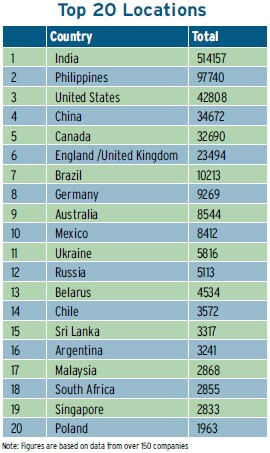
According to the 2010 Global Services 100 list, Ukraine is 11th and Belarus is 13th among 20 leading countries in the area of IT Outsourcing and High Tech Services. The GS 100 list is annually compiled  by Global Services in association with NeoAdvisory, a consulting and advisory company.

This year more than 150 companies participated in the annual survey and analysis of the global ITO-BPO industry. The companies were asked to share detailed information through an online survey which contained over 200 data inputs and qualitative parameters. The GS 100 model for analysis includes such criteria as management excellence, customer maturity, global delivery maturity, and breadth of services portfolio.

According to Global Services, the top leading countries in IT-outsourcing by number of developers employed are: India (514,157 developers), Philippines (97,740 developers) and USA (42,808 developers). Ukraine is at 11th place with 5,816 employed developers, and Belarus is at 13th, with 4,534 developers. The number of developers is based on the data provided by the companies who opted to participate in the survey. The companies from USA and Canada form the majority of rating participants (37%), while 33% of the companies represent India, 9% are based in Europe, 9% in Latin America, 6% in China, and 5% are in Asia.


Introducing Country Profiles on Nearshore Blog

Dear Readers,


We're glad to announce the start of Country Profiles series on the pages of Nearshore Blog. The country profiles series include profiles of countries within the Central and Eastern European region with general information about the country, its economical and educational spheres as well as perspectives on provision of Nearshore IT services to Western European countries.

The series will be represented by the special sections "Nearshore destinations" tab on the right and upper menu on this blog as well as special articles, dedicated to each country.

With the growing Nearshoring trend and strengthening position of Central and Eastern European region at the global IT outsourcing arena the need in better information supply arose. The main objectives of the country profiles series is to provide sufficient information about IT outsourcing capabilities and latest developments in leading nearshoring destinations in Central and Eastern Europe.

Please see the country profiles sections to find out more about leading nearshore destinations.

First Ukrainian IT outsourcing company turned 21 - great mark for whole industry

Already for 21 years the last days of September, which are widely known here in Ukraine as a “golden autumn” have already became traditionally recognizable as symbolical time for Ukrainian IT outsourcing industry. These days the first professional IT outsourcing company in Ukraine celebrates 21 anniversary of its foundation.

Levi9 Ukraine, formerly known as Mirasoft celebrates its 21th anniversary this year. September 24 is official company day at Levi9 - the date which encompasses more than two decades of pioneering Information Technology and spreading the word about Ukrainian technological capabilities around the world.

Being one of the first professional software development companies in USSR Levi9 Ukraine represented the potential of Ukraine, which was the major hub of scientific and space industries for the Soviet Union. With leading scientists and engineers from the Kiev Institute of Cybernetics on board Levi9 Ukraine quickly gained attention of the Western companies and signed its first IT outsourcing contract already in 1990.

Since that time much progress has been done and the Ukrainian IT outsourcing market has grown to become one of the biggest in the Central and Eastern European region with the market volume ($844 Mln) and most employees involved in the industry (16000). Today, Ukraine considered as the most compelling destination for IT outsourcing services in Eastern Europe and attracts many world’s premier companies. The country boasts of 30,000 IT graduates each year and allocate established IT associations and alliances, namely Ukrainian Hi-Tech Initative and Central and Eastern European Outsourcing Association(CEEOA).

Many experts associate Ukraine and its closest neighbor Belarus with the rise of Nearshore outsourcing trend in the region. Being the closest to Europe out of those which not have joined the EU, Ukraine offers very attractive opportunities to the West European companies to explore its IT opportunities, with language and cultural ties, no time-zone differences, legacy of Soviet science, strong educational system and a huge pool of highly-skilled resources. According to acknowledged research agencies, such Global Offshore Associates Limited Ukraine is to be converted in the most arresting IT outsourcing destination in Eastern Europe in next several years.

From this point, Levi9 Ukraine and other established IT outsourcing players have a great chance to continue the mission started 21 years ago by brave enthusiasts and pioneers from the Kiev Institute of Cybernetics who today celebrate their success with friends, partners and colleagues.

Leading online Entrepeneur of the year 2010

This was the first time that the Loey awards were organized. A great event. Sea article. http://www.telegraaf.nl/mijnbedrijf/7536289/__Zoover_wint_eerste_LOEY-award__.html?sn=mijnbedrijf

Will the Cloud computing displace traditional IT outsourcing?

Browsing through the web last week I found an article with quite a strong title “The end of outsourcing?!”, written by my friend and fellow IT outsourcing expert. In the article he argued about the prediction made by the head of the outsourcing practice at consultancy A.T. Kearney. In its report “The End of IT Outsourcing As We Know It” Mr. Arjun Sethi states: "In the next five years, outsourcing as we know it will have disappeared." Well, I would say rather bold prediction, especially taking into account recent predictions about the “upcoming golden age of outsourcing”, nevertheless let’s try to find out the probability of such prediction.

There have been much said about the future of IT outsourcing lately. From the Cloud dominance to global shift in delivery and governance models to reverse sourcing and protectionism. Myself, I conducted several works and started a number of discussions here in LinkedIn with the relation to the Cloud computing and its potential affect on IT outsourcing industry. While I saw many experts predicted growing trend for pay-per-drink model there wasn’t concordance and obvious verdict for the shift inside the industry anytime soon. Of course there are some obvious benefits of this model, such as costs, agility and focus which can provide a whole new set of opportunities for both business and individuals. But for the corporate sector, bread and butter of IT outsourcing, all they don’t outweigh security, reliability and ownership of proprietary systems yet. Moreover, investments made by corporations into the existing infrastructure slow down adoption in the sector.

In his forecast, however Mr. Arjun Sethi associates massive reconfiguration of IT ousourcing industry, that according to him should take place in the nearest future precisely with the rise of the Cloud computing. The new era will be driven by Google, Amazon and bunch of new players, while powerhouses such as HP, Accenture and Xerox are in peril to lose their leading positions, and boutique Indian outsourcers poised to disappear at all. Well, it is quite truth that we are moving away from large multi-year full stack contracts towards more specialized, smaller service agreements, but with the current massive consolidation many of those specialized providers will be under umbrella of those big ones.

I also agree that the Cloud brings huge opportunities for highly-configurable systems that might fit needs of many sectors and industries, but standardization which, according to Sethi will feature the revolution in industry is unlikely. Although, today all major software houses and providers include cloud computing offerings in their portfolio, most of them just contemplate their core offerings with the Cloud options, even Microsoft - the company that announced a company-wide refocusing on cloud computing still fully relies on its software installed in physical assets. It will take more than a year or two or even three to change their model.

Although cloud computing experienced a phenomenal growth during last years, it's still in its infancy in corporate sector - cash cow of IT outsourcing industry. No doubts it will grow, grow fast, especially in SME sector, but it will take a good amount of time to make this transition to fully based pay-per... model. And still much should be done before we can signify the new era - meanwhile, forgive for my prejudice I don’t see end of traditional outsourcing.

Will be glad to know other opinions. Please join the conversation in Linkedin, click here.

The Creative Cradle mission by NL EVD International will gathers top decision makers from Netherlands and North America

NL EVD International - a department of the Dutch Ministry of Economic Affairs that implements government policy for sustainability, innovation, and international business and cooperation organizes a Creative Cradle mission which involves prominent decision makers from North America visiting the Netherlands for series of matchmaking and networking events.

Most of US companies seek international cooperation, a new technology or creative impulse and are interested in the Netherlands as a creative hub for Europe. The host cities for the mission are Amsterdam and Rotterdam.

The mission will be held on September 25, 2010.

Starting a Nearshoring # hashtag on Twitter

Almost for everyone who uses Twitter more than once in a month, a shashtag or # prefix is quite familiar. The prefix is a simple way to indicate the belonging of your tweet to some topic, so that people who search for tweets with similar topic can easily find your.

So, even if you don't indicate the keyword "nearshoring" in your tweet but place a #hashtag anywhere except the end, your tweet will appear on relevant search.

So we decided to start a #nearshoring hashtag to share ourselves and allow you to share useful info by adding #nearshoring to our tweets


Has the recession changed outsourcing drivers for SME's and large companies?

Surely, there were a number of different aspects of outsourcing between enterprise and SME sectors even before the crisis. Outsourcing played different roles and spanned around different areas in each league. However, before the crisis some trends became widely common. Both sectors showed move towards more strategic forms of outsourcing where costs reduction wasn't only one major factor that drove outsourcing decisions. The crisis, however is deemed to change this trend. In volatile economic climate of last years many experts distinguished outsourcing drivers for each sector - claiming that large companies want to globalize and cut costs, while small and mid-sized seek expertise.

According to the latest survey by National Outsourcing Association the focus on the costs reduction has risen significantly among large end-users of outsourcing in UK. Today's big customers want 15 percent savings from outsourcing compared to 10 percent before the recession, while the time they want to achieve reduction has shortened. Access to the specialized skills and offloading of internal resources for mission critical processes ranked distant second and third positions.

At the same time another survey focused specifically on SME sector came with different indications. According to the survey conducted by Irish-based HiberniaErvos Technology Group, 63 percent of SME's who already utilize outsourcing put the ability to free up internal resources and focus on business-critical processes as a major benefit of outsourcing.

So is it just a specifics of each sectors? or there are more inclusive post-recession factors on place (such as difficulties for SME's to compete for qualified talent domestically or shortened time-to-market)?


Join the LinkedIn discussion on related subject here

Strategic Sourcing 2010: Driven by value!

Strategic sourcing is at its crossroads. Many organizations are re-evaluating their sourcing contracts. How about strategy, sourcing governance, supply and demand management? Enterprise and government are ready for a change, a move to get more value out of sourcing relationships!

For IT executives this means they have to become business partners and at the same time challenge their vendors and business counterparts: in the end it’s not really about cost savings – it’s all about business value! So the question is: What is the value of sourcing?

Nearshore Outsourcing Trend Grows Across the World

Although Nearshoring concept became a widely popular business practice across the Europe it's still in emerging phase in the Western Hemisphere mainly because of strong popularity of India offshore offerings. However, escalating uncertainties of regional threats in India combined with increased focus on vulnerability management and demand to keep data close to where business actually located have changed delivery preferences of US businesses towards nearshore and sameshore options.

Recent ranking "The Nearshore Americas Power 50" named the most influential Nearshore figures from 16 countries from Americas region. The region is considered to be the main nearshoring destination for US and viable alternative to offshoring to India. The $11 billion industry has all chances to successfully compete with offshore destinations as realities of unsafe world have fully overrun into outsourcing decisions. Focus on vulnerability management and operating with lowest downstream risks help nearshoring destinations to attract more attention.

The survey being made by Black Book Research indicates that Central and Eastern Europe and Latin America are viewed as significantly less dangerous outsourcing locations that all major hubs of India and being marked as the top destinations for operating with lowest downstream risks. Having services centers nearshore and sameshore will be a major client priority in years to come.

From other side in nerarshoring study conducted by Erran Carmel and Pamela Abbott argue convincingly that distance still matters, and point to customer choosing the nearshore option to gain benefit from one or more of the following constructs of proximity: geographic, temporal, cultural, linguistic, economic, political, and historical linkages.

Central and Eastern Europe is significant nearshoring destinations for Western Europe for more than a decade. Where geographical and cultural proximity provides with lower costs interaction, better communication and no time zone difference. As a result project management became more transparent, time zone eliminates the need in extra work and cost difference dilutes.

ISV's Lunch Seminar in Amsterdam - The Art of Software Dev

On June 16, Levi9 Global Sourcing in conjunction with the University of Utrecht, Microsoft Corp and Exact Software is hosting an IT industry specific lunch seminar.

The seminar will be held in Amsterdam, and will gather under one roof some of leading IT professionals and scholars from the Netherlands. Among keyspeakers there are such distinguished panelist as Prof. Dr. Sjaak Brinkkemper, Professor of Organization and Information Utrecht University with specialization in software products and Roland Janssen, Manager ISV Partner Group, Microsoft, Gerard Hurkmans, sales manager Levi9 and Aard ’t Hart, Director of Research & Innovation, Exact Software

The seminar is oriented on Independent Software Vendors (ISV's) and will attract executives and senior level professionals of leading tech companies in the Netherlands. The event will provide unique opportunities for ISV's to delve into the process of nearshore outsourcing and get real recommendations and advices for the effective adoption of the practice within corporate strategy.

Moreover, panel and knowledge exchange sessions will be held to raise the standard of management knowledge in this field. Session will kick off at 11:30 a.m. and will be followed by coffee reception at 1.45 p.m.

To register for seminar please click here.

EC demands more progress towards a single telecoms market

Digital Agenda Commissioner Neelie Kroes has lambasted EU member states for putting their national interests above efforts to achieve the full economic benefits of a "truly single and competitive EU-wide telecoms market".

Fragmented national markets and huge differences in mobile call rates are affecting hundreds of thousands of consumers and businesses, according to Kroes.

Member states need to do more to ensure telecoms rules are properly implemented and the necessary investments in innovative services are made for the benefit of all 500 million European consumers, she said.

Kroes said more progress needed to be made in the development of the mobile data services sector and the rollout of optical fibre-based next generation access (NGA) networks.

As the commissioner in charge of the recently launched EU Digital Agenda, Kroes is expected to put forward new recommendations on how NGA network rollouts can be made faster later this year.

The EU Digital Agenda aims to deliver broadband coverage to all Europeans by 2013. To help achieve this, national regulators are being urged to comply with a Radio Spectrum Policy Programme that aims to ensure radio frequencies that are freed by the transition to digital broadcasting (the "digital dividend") are made available for new services, such as mobile broadband.

To help drive forward its Digital Agenda, the EC recently establishd the Body of European Regulators for Electronic Communications.